
Searching for our Ancestors
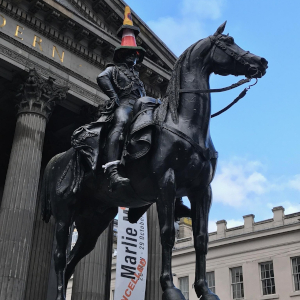
The equestrian statue of Field Marshal Arthur Wellesley, 1st Duke of Wellington, is located outside the Gallery of Modern Art, Glasgow (formerly the Royal Exchange).
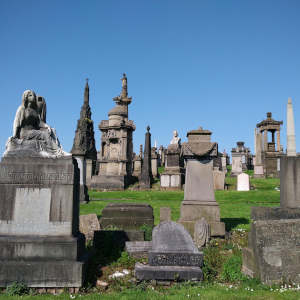
A Victorian cemetery in Glasgow. It is on a low but very prominent hill to the east of Glasgow Cathedral. Fifty thousand individuals have been buried here.
Glasgow, founded by St. Mungo in the 6th century as a religious settlement on the River Clyde, grew into a medieval burgh and eventually a global industrial powerhouse. Known as the "Second City of the Empire" in the 19th century, it specialized in shipbuilding, tobacco, and engineering before transitioning into a modern cultural hub.
For me, any genealogical journey envolving Glasgow, 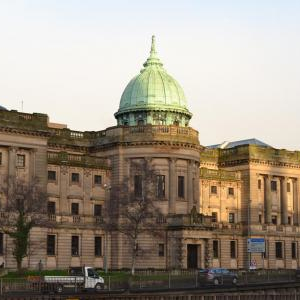 has to include the Mitchell Library. Founded by a £70,000 (probably around £10 million in today's equivalent) bequest from tobacco manufacturer Stephen Mitchell, opened in 1877
on Ingram Street with 15,000 volumes. Due to massive growth, the iconic Category B-listed Edwardian Baroque building on North Street, designed by William B. Whitie, opened in 1911. It is the largest public reference library in Europe, and the centre of Glasgow's public library system.
has to include the Mitchell Library. Founded by a £70,000 (probably around £10 million in today's equivalent) bequest from tobacco manufacturer Stephen Mitchell, opened in 1877
on Ingram Street with 15,000 volumes. Due to massive growth, the iconic Category B-listed Edwardian Baroque building on North Street, designed by William B. Whitie, opened in 1911. It is the largest public reference library in Europe, and the centre of Glasgow's public library system.
The Mitchell Library, as part of it's Family History Department, has one of the Scotland's People satellites. You can this search room for £15 for about a 5½ hour session. You can click on as many records as you like during that session. You can also view records that are within the statutory "wait time limt", records right up to the present time (although it does take several months to appear for administrative and technical reasons). You can print any records that are within the statutory "wait time" (births, older than 100 years, marriages, older than 75 years, deaths, older than 50 years) but you cannot print the records within these times.
The Mitchell Library houses the Glasgow City Archives, Special Collections, Leisure and Lifestyle and General Services. While they were a reference library until 2005, they now lend many of their books and new titles are added to their catalogue regularly.
There is a community library and a cafe where you can meet friends for a chat. Free Wi-Fi and computers to get you online. Events and exhibitions to enjoy. And quieter areas to relax away from the rush of everyday life.
The next organisation I'd like to highlight  respect of genealogy in a Glasgow perspective is the Glasgow and West of Scotland Family History Society.
In 1977, a newspaper advert invited interested parties to come to a meeting with a view to forming a new Society to "promote the study of family history in Glasgow and the west of Scotland" and the Glasgow & West of Scotland Family History was founded as a Charity run by a Council of volunteers.
By October 2005, however, the Society had outgrown it's original premises, and moved to the present premises at Unit 13, 32 Mansfield Street. This was a mammoth task undertaken by members who volunteered their time and expertise. There are now six research computers with internet access, printing and photocopying facilities, film and fiche readers and a separate library room.
Over the years, Society members have taken part in transcribing monumental inscriptions at various cemeteries, notably Glasgow Cathedral, lair records at the Southern Necropolis and indexing pre 1855 deaths and burials in Scotland. The work goes on and the results are available to view at the Research Centre which is well worth a visit.
As a large city, as you can expect, it has many graveyard to explore. 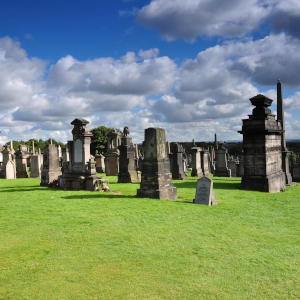 The main one of historical significance is that of the one mentioned at the top. The Glasgow Necropolis.
In 1650 the Merchants' House bought the land, part of the estate of Wester Craigs, now known as the Glasgow Necropolis. As the west side was rocky and not able to be developed it was subsequently planted with fir trees and became known as Fir Park. However, in 1804, the Scots Firs in the park started to die and were replaced by mainly elm and willow and the area became a Victorian park and arboretum. In 1825 the foundation stone of the John Knox monument was laid in Fir Park.
This burial ground was always intended to be interdenominational and the first burial in 1832 was that of a Jew, Joseph Levi, a jeweller. In 1833 the first Christian burial was of Elizabeth Miles, stepmother of the Superintendent, George Mylne. After 1860, the first extensions east and south were to take up the Ladywell quarry and in 1877 and 1892/3, the final extensions to the north and south-east were constructed, doubling the size of the cemetery. The Necropolis is now 37 acres (15 ha).
50,000 burials have taken place at the Necropolis and most of 3,500 tombs have been constructed up to 14 feet deep, with stone walls and brick partitions. On the top of the Necropolis, tombs were blasted out of the rockface. In 1877 the Molendinar Burn, running under the Bridge of Sighs, was culverted. This burn in which St Mungo was said to have fished for salmon is now underground on its way to the Clyde.
The Necropolis was one of the few cemeteries to keep records of the dead, including profession, ages, sex and cause of death. In July 1878 the visitors book shows that 13,733 people visited the Glasgow Necropolis, 12,400 citizens and 1,333 other visitors. The Glasgow Necropolis still has a wonderful atmosphere and still attracts many visitors both locally and from all over the world.
No matter where you go in Glasgow, you are surrounded by history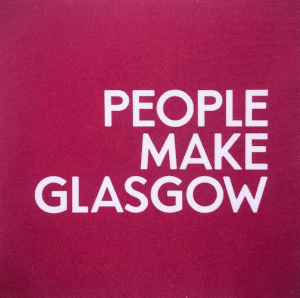 and therefore the ghosts of your ancestors. It is a fascinating city to visit especially with all it's arts and culture. For me it's the best city in the world but I guess I'm biased having been born there and living there until I was
around 32. If you are visitng it to trace your roots, be assured you will enjoy it. As the city's motto now says, "People Make Glasgow" which is the official, crowd-sourced brand for Scotland's largest city, launched in 2013 to highlight the warmth, friendliness, and spirit of its residents.
and therefore the ghosts of your ancestors. It is a fascinating city to visit especially with all it's arts and culture. For me it's the best city in the world but I guess I'm biased having been born there and living there until I was
around 32. If you are visitng it to trace your roots, be assured you will enjoy it. As the city's motto now says, "People Make Glasgow" which is the official, crowd-sourced brand for Scotland's largest city, launched in 2013 to highlight the warmth, friendliness, and spirit of its residents.
You only have to look at the first picture above to understand the humour of Glaswegians. Since its first appearance, various jobsworths have tried to stop the ducal decor in the name of health and safety, but in Glasgow, you may as well try to stop the rain from falling. Plans to raise his plinth or install CCTV to deter the Duke's comical coronation were loudly opposed, with a "keep the cone" campaign launched to preserve his hallowed headwear. Unlike Wellington, the council eventually admitted defeat and the cone has been a permanent fixture ever since, proving that Glasgow spirit will always prevail.
I certainly would never claim to be an expert, in anything really, but I know my own city well and if you ever need to ask me anything about it, please don't hesitate to contact me.
I make every effort to document my research. If you have something you would like to add or discuss, please do not hesitate to contact me.

